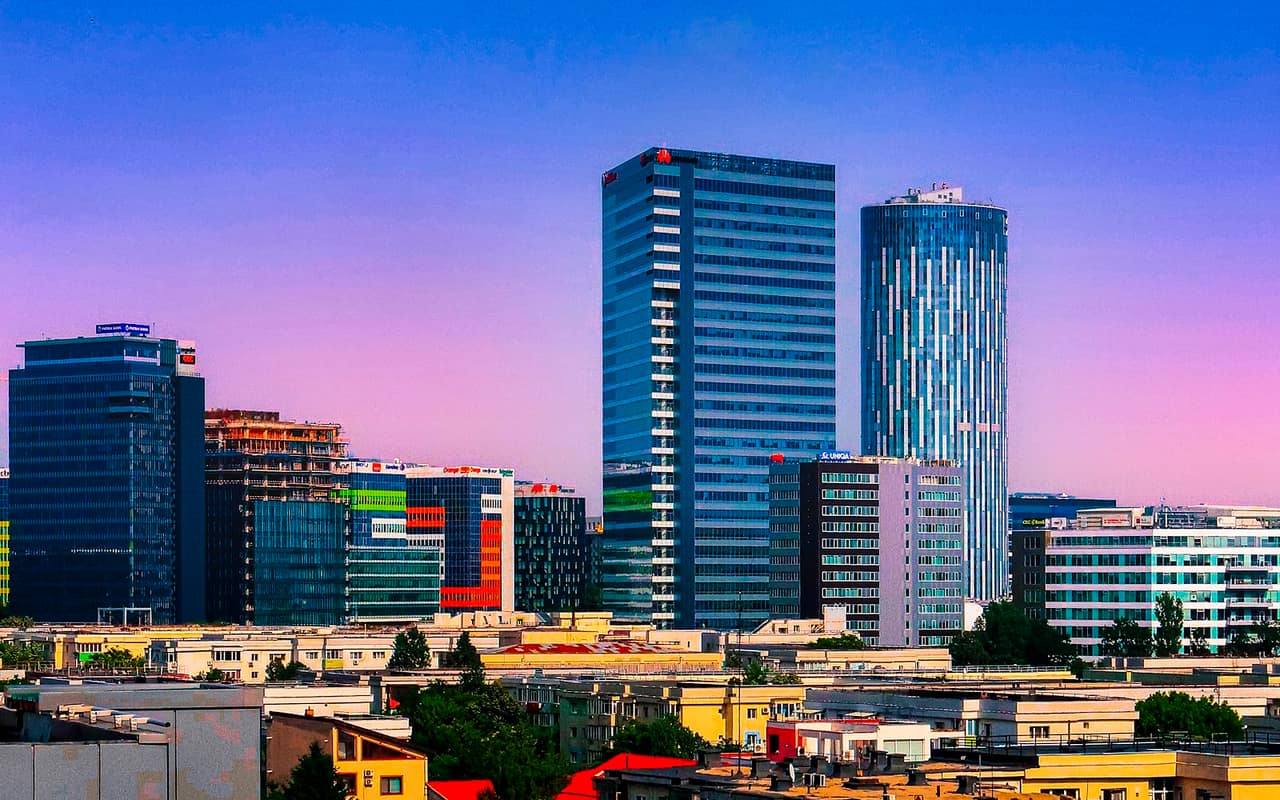
Bucharest concentrates most of the country's economic activity. This is where the big corporate headquarters sit, where the financial institutions are based, where most service-sector jobs are, and home to one of the region's largest office markets. In short, it is where business in Romania happens.
Main industries
The city's economy is service-led: IT and software, finance and banking, consulting, business process outsourcing (BPO), retail and hospitality. Industry and logistics have largely moved to the outskirts and the ring road, while the centre has become office, commerce and services territory.
This shift mirrors a wider pattern in European capitals: as manufacturing migrated to lower-cost belts around the city, the core specialised in higher-value services. The result is a workforce weighted toward offices, banks, technology firms and the professional services that support them, rather than the factories that once defined parts of the city.
Business hubs
A few poles hold most of the modern offices. Pipera is the largest office and tech cluster in the north, with sprawling campuses — see the Pipera neighbourhood. The Floreasca / Barbu Văcărescu area has turned into a corridor of office towers and corporate headquarters; details in Dorobanți–Floreasca. The city centre keeps institutions, banks and professional-services firms.
The reason these poles concentrated in the north is partly historical and partly practical: proximity to the main airport corridor, available land for large campuses, and good connections to the wealthier residential districts from which much of the workforce is drawn. Over time, this has reinforced the north as the city's primary business axis.
IT, startups and investment
Bucharest is the country's main tech centre, with a deep pool of engineers, product companies and offices of international firms. The startup ecosystem has grown steadily, supported by technical talent and competitive costs. Foreign direct investment flows mostly into services, technology and real estate.
The talent pipeline is closely tied to the city's strong technical universities, which feed a steady supply of engineers and developers into both multinationals and homegrown product companies. Competitive operating costs compared with Western Europe, combined with this talent base, are the main reasons international firms continue to open and expand offices here.
Retail, real estate and fairs
Modern retail shows up in large malls and commercial arteries, while the office market remains the real-estate driver. For trade fairs and exhibitions, Romexpo is the city's main exhibition centre, hosting the big business and consumer events.
Alongside the malls, traditional commercial streets and markets continue to play a role, and a growing wave of restaurants, cafes and hospitality venues - especially in and around the Old Town - has turned the centre into a leisure and nightlife economy in its own right. The office sector, however, remains the heart of the real-estate market, with the northern corridors absorbing most new development.
City context
The economic pulse shows directly in traffic and transport demand — see getting around Bucharest. Much of the workforce comes from the city's universities; read about education and universities.
Why business concentrates here
Bucharest's dominance is self-reinforcing: companies locate where the talent, clients and infrastructure already are, which in turn attracts more talent and more companies. As the seat of government, the financial system and the main airport, the city offers a density of opportunity unmatched elsewhere in the country. For anyone working, investing or doing business in Romania, the capital is almost always the natural starting point.