A few buildings condense the city's history and appear on every postcard. Below are the essential landmarks — for everything you can visit, see attractions. Most are concentrated along a relatively short corridor between Victory Square and Unirii Square, which makes them easy to cover on foot.
The Romanian Athenaeum
The city's emblematic concert hall, built to the plans of French architect Albert Galleron and inaugurated in 1888, in a neoclassical style with a dome. It is home to the "George Enescu" Philharmonic and one of Romania's cultural symbols. The building was financed in part by a public subscription, under the slogan "Give a leu for the Athenaeum," and the great hall is decorated with a circular fresco depicting moments from Romanian history.
The Palace of the Parliament
The colossal edifice built in the 1980s under Ceaușescu, one of the largest administrative buildings in the world. Its construction required demolishing a large part of the old city, in the area of Uranus hill. Today it houses the Parliament and a contemporary art museum (MNAC). Part of the rooms can be visited on a guided tour with prior booking.
The Arch of Triumph
The present stone arch was built in 1935–1936 to the design of architect Petre Antonescu, on the site of earlier wooden arches. It commemorates Romania's victory and unification after the First World War. It stands in the north of the city, on Kiseleff Road, and inside it has a staircase leading to a terrace open to the public on certain days.
The House of the Free Press
Formerly Casa Scânteii (1952–1957), in socialist-realist style, inspired by the central tower of Lomonosov University in Moscow. It was the tallest building in Bucharest for half a century. Today it houses newsrooms, publishers and offices, and a wide esplanade stretches in front of it, a fixture for events and walks.
The CEC Palace
A landmark on Calea Victoriei, built to the plans of architect Paul Gottereau and opened in 1900, in French eclectic style, with its glass-and-metal dome. It stands opposite the National History Museum of Romania (the former Post Office Palace), forming one of the most photographed frontages on Calea Victoriei.
The University of Bucharest
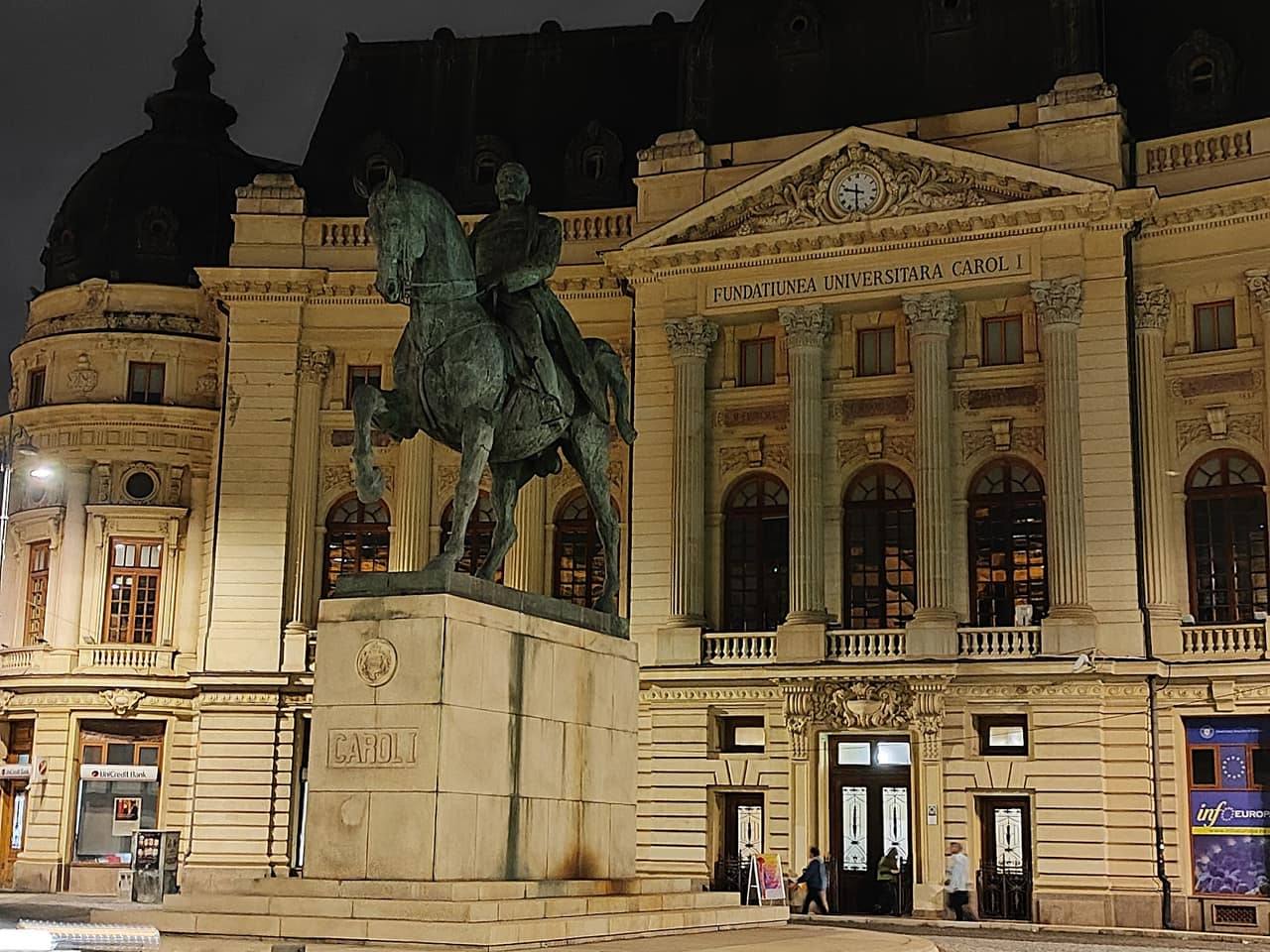
The historic building in University Square, a reference point of the city's academic and civic life. The square in front of it was, in December 1989 and afterwards, a central place of demonstrations — the so-called "kilometre zero" of the protests. The exact dating and author of the original wing remain to be verified.
Manuc's Inn
An old caravanserai built in 1808 by the Armenian merchant Manuc Bei, in a Brâncovenesc-inspired idiom. Today it works as a restaurant and is one of the most photographed courtyards in the Old Town. Its inner courtyard with two levels of wooden galleries is one of the few surviving inn structures from the old merchant city.
The Old Princely Court
The remains of the medieval Princely Court, the nucleus around which the city formed, linked to the reign of Vlad the Impaler. This is, in effect, where Bucharest's history begins. The Old Court Church (St Anthony's) stands here too, considered the oldest surviving church in the city.
The Royal Palace (MNAR)
A former royal residence on Calea Victoriei, today the seat of the National Museum of Art of Romania (MNAR), with collections of Romanian, European, and Oriental art. The building faces Revolution Square, where the Memorial of Rebirth also stands, dedicated to the victims of December 1989.
Stavropoleos Church
A small jewel in Brâncovenesc style, consecrated in 1724, renowned for its carved facades, stone columns, and quiet courtyard in the heart of the Old Town. The monastery holds a valuable collection of icons and old books and is known for its Byzantine-music choir.
In short, for a walking tour
Almost all the landmarks above can be linked into a single walk along Calea Victoriei, completed by a detour into the Old Town for the Old Princely Court, Manuc's Inn and Stavropoleos. For location and opening hours, open each landmark's page under attractions.