Bucharest is a city written in layers, with no dominant style. Look closely and you see four or five eras stacked on the same street. For specific buildings, see attractions and the article on monuments and symbols. It is precisely this layering — rather than any single monument — that is the city's architectural signature.
Brâncovenesc and the neo-Romanian style
The oldest layer with a clear identity is the Brâncovenesc — arcades, carved columns, stone frames — visible in churches such as Stavropoleos (1724). The style took shape at the turn of the seventeenth and eighteenth centuries, under Prince Constantin Brâncoveanu, as a synthesis of local tradition, Byzantine influences and Venetian elements. In the early twentieth century, architects like Ion Mincu reinterpreted it as the neo-Romanian style, a deliberate search for a national language; Mincu himself is regarded as the father of the movement, and examples range from private houses to interwar public buildings.
Eclecticism and neoclassicism
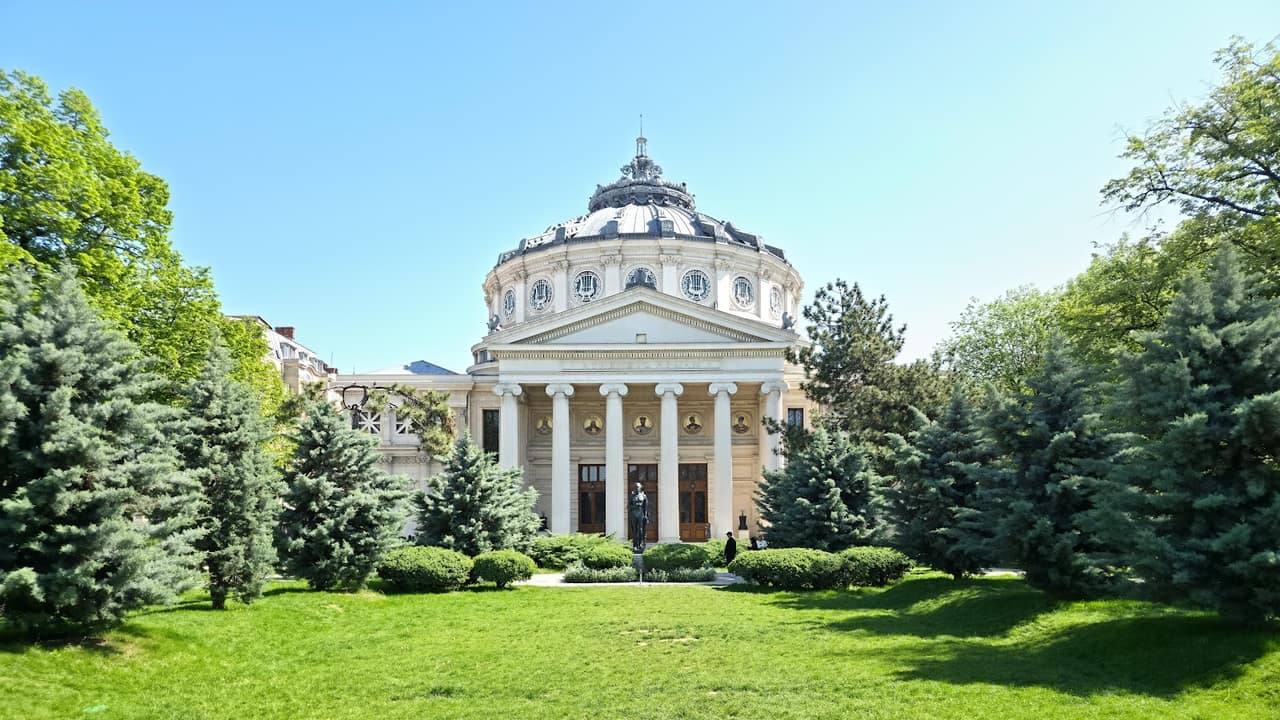
The second half of the nineteenth century brought French-inspired eclecticism, the reason Bucharest was once called "Little Paris." The CEC Palace (Paul Gottereau, opened 1900) and the Romanian Athenaeum (Albert Galleron, 1888) are the textbook examples. The same period saw boulevards laid out on the Parisian model and a series of boyar palaces and public institutions that gave the city the air of a Western capital.
Art Deco and interwar modernism
Between the two wars, the city became a laboratory of modernism. Magheru Boulevard concentrates the densest collection of interwar modernist architecture — geometric tower blocks (blockhaus), holding hotels, apartments, and institutions — alongside Art Deco facades. At the time, it was something almost unique in Europe. Architects such as Horia Creangă and Marcel Iancu (linked to the artistic avant-garde) set the tone, and buildings like the ARO block (today the Patria Cinema) became landmarks. Many of these buildings are now listed as monuments.
Communist monumentalism
After 1947 came socialist realism, then the late gigantism of the Ceaușescu era. The House of the Free Press (formerly Casa Scânteii, 1952–1957) is inspired by the Stalinist towers of Moscow; the Palace of the Parliament and the Civic Centre axis razed entire neighbourhoods for a scenography of power. The 1980s "systematisation" demolished churches, houses and whole streets in the Uranus–Antim area to make room for the Victory of Socialism Boulevard (today Unirii Boulevard) and the administrative ensemble.
Protected heritage and abandoned buildings
Many historic buildings are protected as monuments, but their condition varies dramatically — from exemplary restorations to buildings with a "red dot" seismic-risk label and interwar houses left to decay. The "red dot" marks buildings classified in seismic-risk class I, a warning visible on many old buildings in the centre. The tension between conservation and neglect is one of the city's great urban problems. Precise figures and dates should be verified case by case.
How to read the city on foot
The best way to understand Bucharest's heritage is a slow walk along a few key arteries: Calea Victoriei (from the Old Princely Court to Victory Square) for eclecticism and the interwar period, Magheru Boulevard for modernism, the Cotroceni area for neo-Romanian houses, and the Unirii axis for communist monumentalism. Look up above the commercial ground floors — that is often where the original details survive.