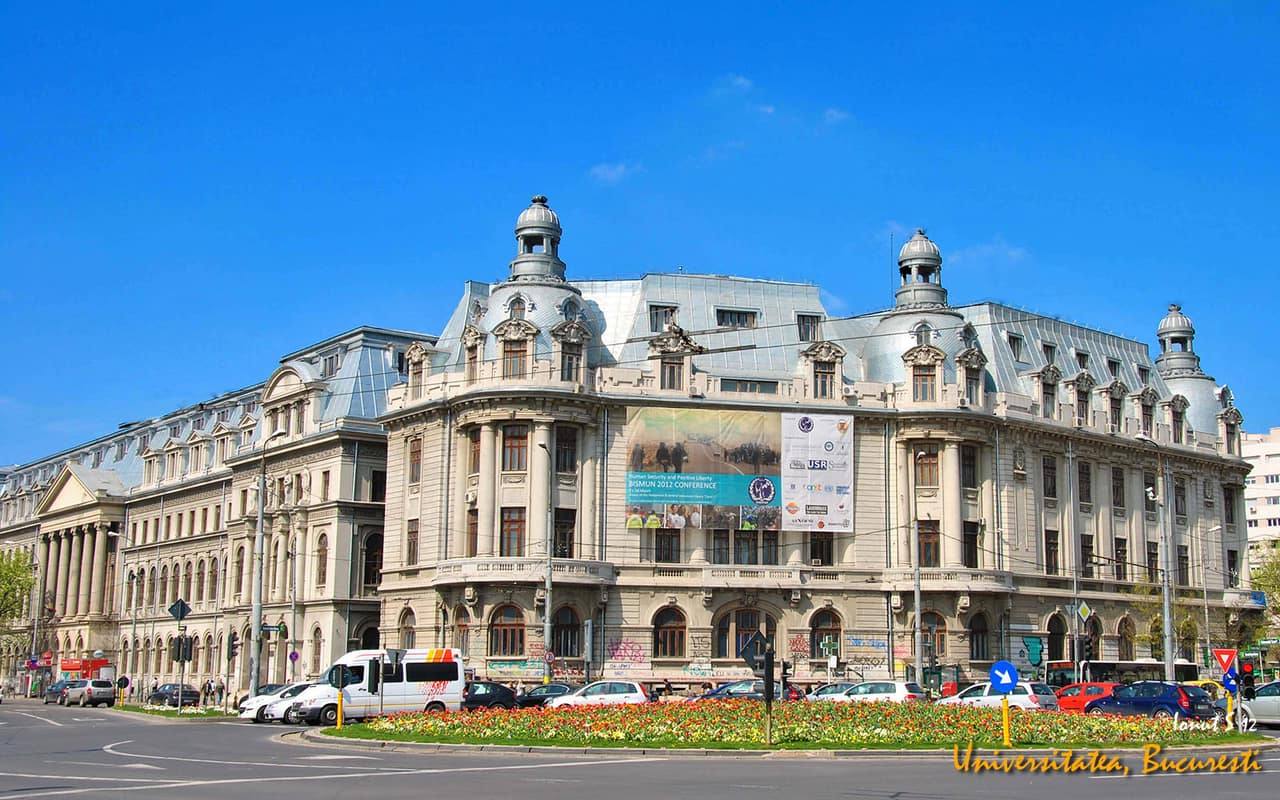
Bucharest is the country's largest university centre, with tens of thousands of students and Romania's best-known higher-education institutions. For many young people from across the country, moving to the capital to study is a rite of passage, and the academic calendar shapes whole neighbourhoods: rents, cafés, libraries and nightlife all move to the rhythm of the semester.
The city's academic tradition runs deep. The University of Bucharest was founded in 1864 by a decree of ruler Alexandru Ioan Cuza, bringing together the existing faculties of law, sciences and letters into a single institution. In the same period the engineering school that would become the Politehnica took shape, and Carol Davila had already set up the National School of Medicine and Pharmacy in the 1850s. That nineteenth-century groundwork is why so many of the country's flagship institutions are concentrated here today.
The major universities
The city is home to landmark institutions:
- University of Bucharest — a comprehensive university, with faculties of letters, law, sciences, social sciences and many more.
- Politehnica University of Bucharest (UPB) — the country's largest technical university.
- Bucharest University of Economic Studies (ASE) — the main centre for economics and business studies.
- Carol Davila University of Medicine and Pharmacy — the peak of Romanian medical education, consistently among the country's top-ranked universities.
- SNSPA — the National University of Political Studies and Public Administration, for political science and public administration.
- UNATC "I. L. Caragiale" — the National University of Theatre and Film, for drama and cinema.
The list continues with the Technical University of Civil Engineering Bucharest (UTCB), the "Ion Mincu" University of Architecture and Urbanism, and the University of Agronomic Sciences and Veterinary Medicine, among others.
How admission works
Romanian public universities are largely tuition-free for students admitted on state-funded places, with a parallel tier of fee-paying places for those who score below the cut-off. Admission criteria differ sharply by field: medicine and many engineering programmes rely on entrance exams, while several humanities faculties weigh the baccalaureate average and a file of results. Exact thresholds, deadlines and the number of subsidised places change every year, so always confirm on each faculty's official admissions page rather than relying on last year's figures.
High schools and schools
Bucharest has some of the country's most competitive high schools, with strong theoretical tracks in mathematics-informatics, sciences and humanities, alongside a rich offer of private and international schools for expat families. Names and admission criteria change yearly — check official sources before deciding. Placement into the public high schools is driven mainly by the national eighth-grade evaluation and a centralised computer allocation, which is why the best-regarded colleges draw applicants from well beyond their own districts.
Libraries
For study and research, the city has the National Library of Romania and the Central University Library (BCU), alongside faculty libraries. They are landmarks for students and researchers alike. The National Library's modern building near Unirii doubles as a reading and events venue, while the BCU, opposite the former royal palace, holds large humanities and social-science collections. Most faculty libraries also keep specialised reading rooms that non-students can sometimes use with a day pass — useful to know before exam season, when seats are scarce.
Student life
The neighbourhoods with dorms and campuses (Regie, Grozăvești, Pipera and others) carry a distinct energy, with cafés, bookshops and affordable nightlife. Regie, on the edge of the Politehnica campus, is the classic student quarter, packed with cheap terraces; Grozăvești sits beside several dormitory complexes along the Dâmbovița. Student cards bring real discounts on public transport and many cultural venues, which makes the city far more affordable than the headline prices suggest. For context, see tourism in Bucharest and the city economy, which absorbs many graduates.