Bucharest does not have a single style - it has layers. Read carefully, the city tells you a century and a half of history in stone, brick and concrete. Nothing here was planned as a museum: each layer was simply the fashion, the politics or the money of its moment, and the next generation built right on top of it. That is why a single block can hold three centuries at once. Here are the four major layers and where to see them, plus a few habits that will help you spot them on your own.
Belle Époque - "Little Paris"
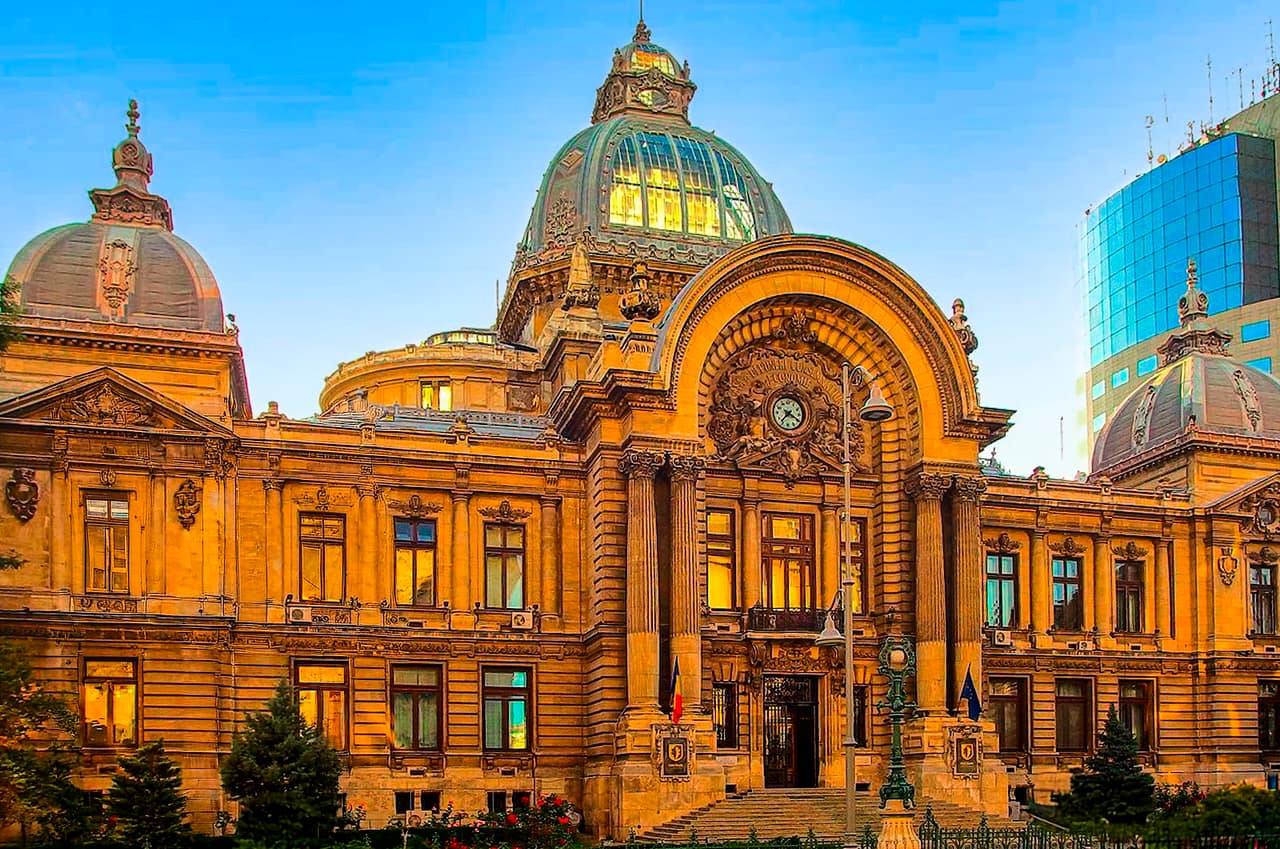
In the late 19th and early 20th centuries, the Bucharest elite imported French architecture wholesale: eclectic façades, mansard roofs, wrought-iron balconies, rich ornament. That is how the nickname "Little Paris" was born. You see it in the old buildings of the Old Town and along the historic boulevards, in palaces and former mansions.
The details to look for are consistent: caryatids and stucco garlands above the windows, tall French doors opening onto narrow balconies, and a symmetrical façade organised around a central axis. Many of these buildings were designed by architects trained in Paris, and the ambition was explicit - the city wanted to look European. Some have been restored to a jewel-box finish, while others stand faded and patched; that contrast between glamour and decay is part of the experience, not a flaw in it.
The Brâncovenesc and neo-Romanian style
The Brâncovenesc style, from the era of ruler Constantin Brâncoveanu (turn of the 17th-18th centuries), blends Byzantine, Ottoman and Western influences - arcades, carved columns, loggias. Later, the neo-Romanian movement (late 19th century to the interwar years) reinterpreted it as a national style. The best example to visit is Mogoșoaia Palace.
What gives the style away: deep open porches, twisted (rope-like) stone columns, horseshoe arches and lavishly carved floral motifs around doorways. The neo-Romanian revival added brick-and-plaster contrasts and steep tiled roofs, and you will find it not only in grand buildings but in interwar villas across the residential districts. Once you know the vocabulary, you start noticing it everywhere - a carved capital here, a loggia there.
Interwar modernism
The 1920s and 1930s brought a remarkable modernist wave to Bucharest: blocks with clean lines, rounded corners, Bauhaus and Art Deco influences. Magheru Boulevard is the calling card of this layer - a row of interwar blocks regarded as a European reference for the period. Look up as you walk along it.
The signatures are easy once you see them: horizontal "ribbon" windows, ship-like curved corners, flat roofs and the near-total absence of ornament. Ground floors were designed for shops and cafés, and many still serve that purpose, which is why the street feels alive at eye level even when the upper floors are quiet. Some blocks keep their original geometric lobbies and railings; step into an open doorway and the period detail is often still there.
Communist monumentalism
The last major layer belongs to the communist regime: Stalinist socialist realism (the Press House) and then the megalomaniac monumentalism of the 1980s (the Palace of Parliament and the boulevard leading to it). It is an architecture of power and scale. For context, read our guide to communist Bucharest.
The two phases look different. The earlier Stalinist work borrows Soviet templates - symmetrical towers, spires, a heavy classicising air. The 1980s monumentalism is colder and bigger: vast white façades, repeating columns, axes designed to dwarf the person walking them. Reading it honestly means asking not just how it looks but what it cost and what it replaced.
How to "read" the city
- Look at the façade and ornament - they tell you the era.
- Look for contrasts on the same street: an interwar villa next to a communist block is typically Bucharest.
- Raise your gaze above the shopfronts; the upper floors keep the story.
- Check the windows: tall French casements mean Belle Époque, horizontal ribbons mean modernism.
- Notice the roofline: mansards and tiles point to the older layers, flat roofs to the modern ones.
Routes by style
- Belle Époque: the Old Town and the historic boulevards.
- Brâncovenesc: Mogoșoaia.
- Modernism: Magheru.
- Communist: Casa Poporului and the Press House.
A practical way to combine them: start in the Old Town for Belle Époque and a coffee, walk up to Magheru for modernism, then judge whether you have the energy for the communist axis in the same afternoon. Mogoșoaia is the one piece that needs its own trip.
Most are reachable on foot or by metro; see the metro guide. For neighbourhood context, districts; for a break along the way, restaurants. For themed architecture tours, look under events.
FAQ
Where is the best place for interwar modernism?
Magheru Boulevard - a compact row of 1930s blocks.
Can I see all the styles in a day?
Yes - on foot in the centre you catch Belle Époque, modernism and communist work; for Brâncovenesc you need a trip out to Mogoșoaia.
Do I need a guide to appreciate the architecture?
Not at all - the layers are visible from the street once you know what to look for. A themed tour helps if you want the stories behind the façades; check events.
Is it worth going inside the buildings?
Where you can, yes - lobbies and stairwells often preserve original detail. For the Palace of Parliament and Mogoșoaia, plan a proper visit; see attractions.