No city in Eastern Europe wears the marks of communism as visibly as Bucharest. The Ceaușescu regime literally rewrote the city's map, demolishing whole neighbourhoods to raise monuments scaled to its ego. Seeing these places today is not about admiring them but about understanding what happened - and about remembering that behind the concrete are real lives that were uprooted. Here is a route, with context, that you can do respectfully in a day.
Palace of Parliament (Casa Poporului)
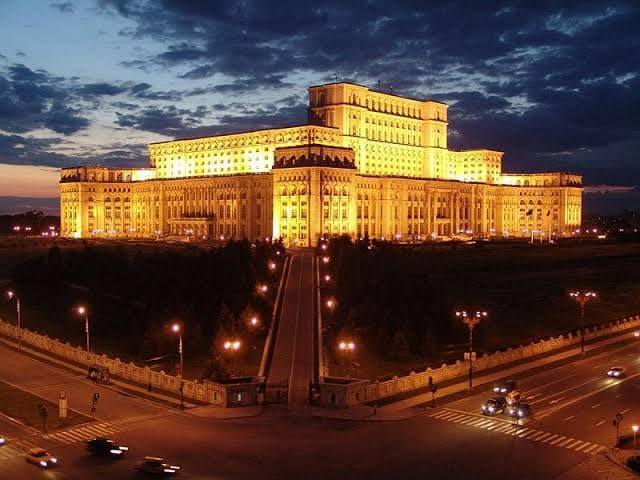
The heaviest administrative building in the world, built in the 1980s at enormous human and material cost. An entire historic district was demolished and tens of thousands of people displaced to make room. Today it houses Parliament and museums, and can be visited on a guided tour. Check the official schedule and booking in advance. See its entry in attractions.
The scale is hard to grasp from photographs: hundreds of rooms, vast marble halls, chandeliers and curtains produced almost entirely from Romanian materials by Romanian workers, often under brutal deadlines. The building was never finished in Ceaușescu's lifetime. Walking the guided route, the question that lingers is not "how grand" but "at what price" - and the honest answer involves rationing, debt and demolition elsewhere in the city.
The Primăverii district and Casa Ceaușescu
Primăverii was the district of the party elite - elegant villas, far from the queues and cold of the rest of the city. It also holds the former Ceaușescu family residence, now open to visitors as a museum. The contrast between this quiet luxury and the era's general poverty is perhaps the city's most honest history lesson.
The house is preserved much as it was: comfortable rooms, a private garden, fittings that were unthinkable for ordinary citizens during years of austerity and power cuts. You do not need a guide to feel the gap between this and the apartment blocks a few kilometres away. Treat the visit as social history, not celebrity tourism, and it becomes genuinely instructive.
Revolution Memorial (Memorialul Renașterii)
A monument to the victims of the 1989 Revolution, set in Revolution Square, the spot where Ceaușescu gave his final speech, cut short by the crowd. It is a place of remembrance, not an attraction; treat it as such.
The square is where the regime cracked in public: the booing crowd, the abruptly ended speech, the days of violence that followed. Standing there, it helps to know you are on the exact ground where it happened. Around the square you can still read the layers - the former Central Committee building, the royal palace, the memorial itself - in a few minutes of quiet attention.
Casa Presei Libere (the Press House)
A monumental tower in the north of the city, built in the Stalinist style (socialist realism) and inspired by the Soviet architecture of the age. Originally named "Casa Scânteii" after the party newspaper, it is today a landmark and a symbol of state propaganda.
Its silhouette - a tall central tower flanked by symmetrical wings and topped with a spire - deliberately echoes Soviet models of the early 1950s. For decades it concentrated the regime's printing and press apparatus in one place, which is the point: architecture as a statement about who controlled the news. Today the area around it is open and easy to photograph from the boulevard.
How to read these places
- Look at the scale: monumentalism was a form of power.
- Ask what was demolished to make room - the story is often in the absences.
- Do not confuse architectural fascination with historical approval.
- Notice who the building was for - the elite or the public - and what that says.
- Keep the human cost in mind, especially at the Palace and in Primăverii.
How to do the route
The sites are spread out but well connected by public transport; plan with the metro guide. For the districts you cross, see neighbourhoods, and for a break, nearby restaurants. If commemorations or themed tours run, they appear under events.
A sensible order is to start with the Palace of Parliament in the morning (book the tour first), move to Revolution Square in the centre, and leave the Press House or Primăverii for the afternoon depending on which direction suits you. None of it needs to be rushed; this is a route that rewards reading and pausing more than ticking boxes.
FAQ
Is the Palace of Parliament worth seeing inside?
Yes, if you want to grasp the scale of the regime. Tours are informative; book ahead.
Is it inappropriate to visit these places as a tourist?
No, as long as you do so with respect and an interest in context, not nostalgia.
How long does the full route take?
A full day if you include a Palace tour; half a day if you stay outside and just read the city.
Can I visit independently or do I need a guide?
The outdoor sites are self-guided; the Palace of Parliament requires a booked tour. A guide adds context but is not essential for the squares and exteriors.