Bucharest has an old habit of hiding its beauty behind grey façades. Blind walls between buildings, gable ends of apartment blocks, abandoned factories - for decades they were just urban background. In recent years, part of this invisible city has started to speak: entire walls have turned into paintings on an impressive scale, visible from the end of a street.
It is not a passing trend but a new layer that has settled over the city - supported by dedicated festivals and by Bucharesters' growing curiosity about their own city. Murals do not replace Bucharest's architecture; they enter into dialogue with it. Here is how to read this new layer, neighbourhood by neighbourhood.
From blind walls to an open-air gallery
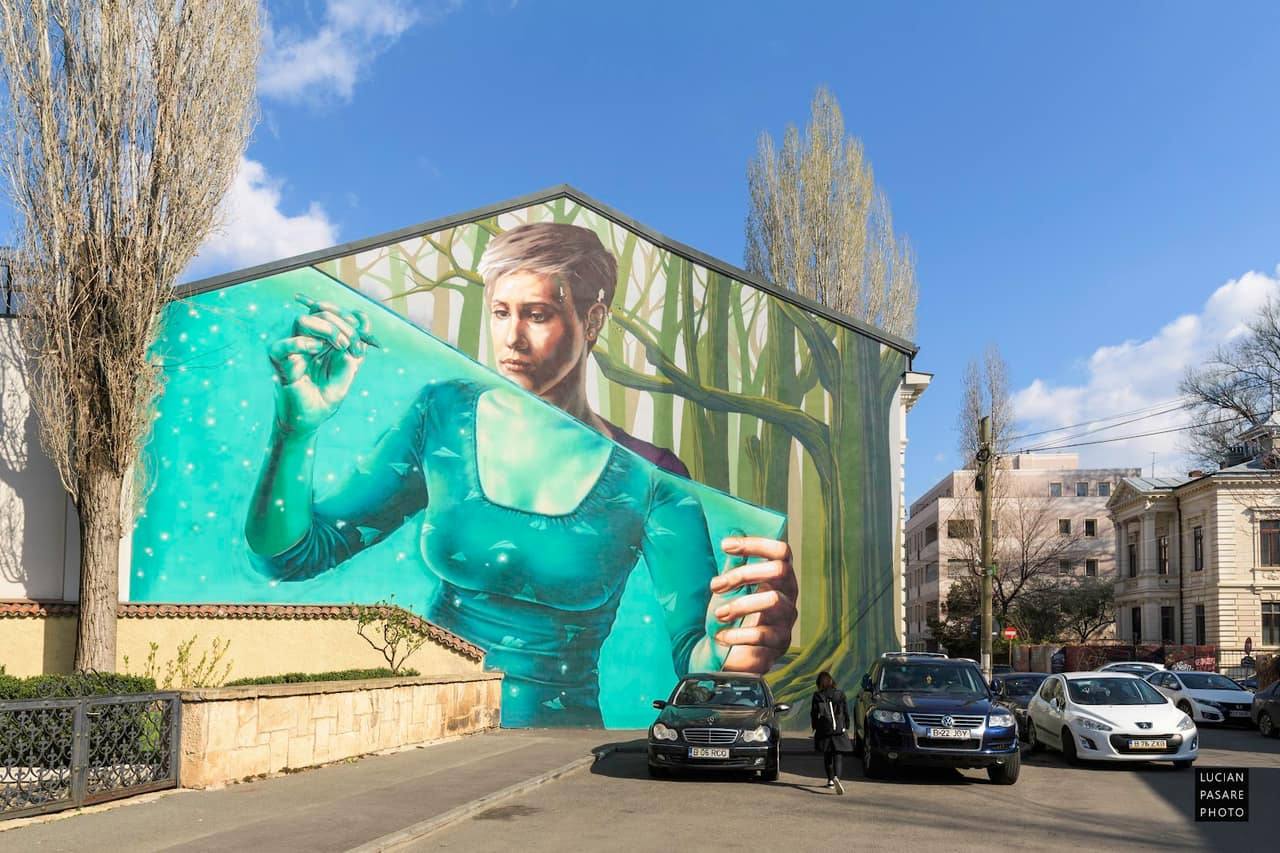
The best-known driver behind this wave has been the Un-hidden Art Festival, an initiative that brought artists to Bucharest specifically to paint façades and gable walls that had stood bare for years. The idea is simple: the city is full of large, blind surfaces on apartment blocks or industrial buildings, and those surfaces can become canvases. The result is visible today across several parts of the city - oversized portraits, abstract compositions, scenes that cover an entire building.
Not everything painted on Bucharest's walls comes from organised festivals. Some of it is more spontaneous street art, signed by local collectives - graffiti, stickers, small interventions. The scale gap is huge, but both belong to the same phenomenon: a city reclaiming its walls.
The contrast that defines the city
What sets Bucharest's street art apart from other capitals is precisely the contrast it appears in. A bold, colourful contemporary mural can turn up on the façade of a grey communist-era block from the 1970s or '80s, a stone's throw from a belle-époque building with wrought-iron balconies. That juxtaposition of different historical layers is, in fact, the city's visual identity itself - a theme we cover in more depth in our guide to Bucharest's architecture.
Large murals often work like a kind of visual correction: where communist-era architecture left monotonous façades, street art introduces colour, human figures, narrative. It does not hide the block - it recontextualises it, turning an anonymous wall into a landmark ("see you by the mural with...").
Where the murals tend to appear
There is no single "official" district for Bucharest's street art - the phenomenon is spread unevenly, depending on where blank walls were available. Broadly, large murals tend to show up:
- On the gable ends of apartment blocks, especially in neighbourhoods built up heavily during the communist period, where blind surfaces between buildings are common.
- In areas with foot traffic, close to commercial streets, where a large-scale painting actually has an audience.
- On repurposed industrial buildings, where street art becomes part of a broader urban regeneration process.
Every neighbourhood in Bucharest has its own mix of architectural eras and, by extension, its own potential for this kind of intervention. If you want a better sense of how the city's areas differ from one another, the neighbourhoods page is the right place to start.
What to look for in a mural
A good mural is not just big - it has a logic to it. A few things worth noticing when you stop in front of one:
- Scale relative to the building. The strongest compositions work with the block's proportions - windows become part of the drawing.
- Technique and palette. Layered paint, fine spray work, realistic portrait brushwork or flat geometric shapes - each artist has a visible signature.
- Relationship to the place. Some murals clearly respond to the specific wall, referencing the neighbourhood; others could be dropped anywhere.
- State of preservation. Exterior paint fades over time, especially on façades exposed to direct sun.
A self-guided walk, map in hand
The simplest way to discover Bucharest's street art is to skip a rigid route and let the neighbourhoods guide you instead. Pick an area with a visible mix of architectural eras - communist-era blocks but also interwar or belle-époque buildings nearby - and walk it on foot, eyes lifted toward gable ends, not just shopfronts.
For orientation, the map is a useful starting point: it shows the city's neighbourhoods and landmarks, so you can build a logical walking route instead of retracing the same streets. Large murals are not always officially marked, but they tend to be visible from a distance precisely because they are large. The best angles are often from the opposite pavement, not right up against the wall.
Street art as a mirror of urban identity
Beyond the visual pleasure, murals say something about how the city sees itself. Bucharest has gone through destruction, reconstruction, imposed ideology and, more recently, a rediscovery of its own identity - a subject we explore in culture and urban identity. Street art is part of that process: it is a way for the current generation to leave its mark on an inherited city, without erasing what came before, but layering over it instead.
That is why a walk among murals is not just a list of pretty photographs - it is a way to better understand the city's layers: old and new, official and spontaneous.
FAQ
Where can I find the most large murals in Bucharest?
There is no single area with all the murals - they appear across different neighbourhoods, especially where projects like the Un-hidden Art Festival have been active. It is most effective to explore a few neighbourhoods with a visible mix of architectural eras.
Is street art in Bucharest legal?
Large murals, of the kind that come out of dedicated festivals, are made with the owners' consent and often with local authorities' approval. Alongside them there is also more spontaneous street art - graffiti and small interventions - whose legal status varies case by case.
How long does a mural-hunting walk take?
It depends on the neighbourhood you choose, but a walk of a few hours focused on a single area is usually enough. Use the map to plan a compact route without unnecessary detours.
Is street art connected to the city's architecture?
Yes, and that contrast is exactly Bucharest's strength: contemporary murals frequently appear on façades of buildings from very different eras, from communist blocks to belle-époque houses. For architectural context, our Bucharest architecture guide explains the layers you often see in the same frame.